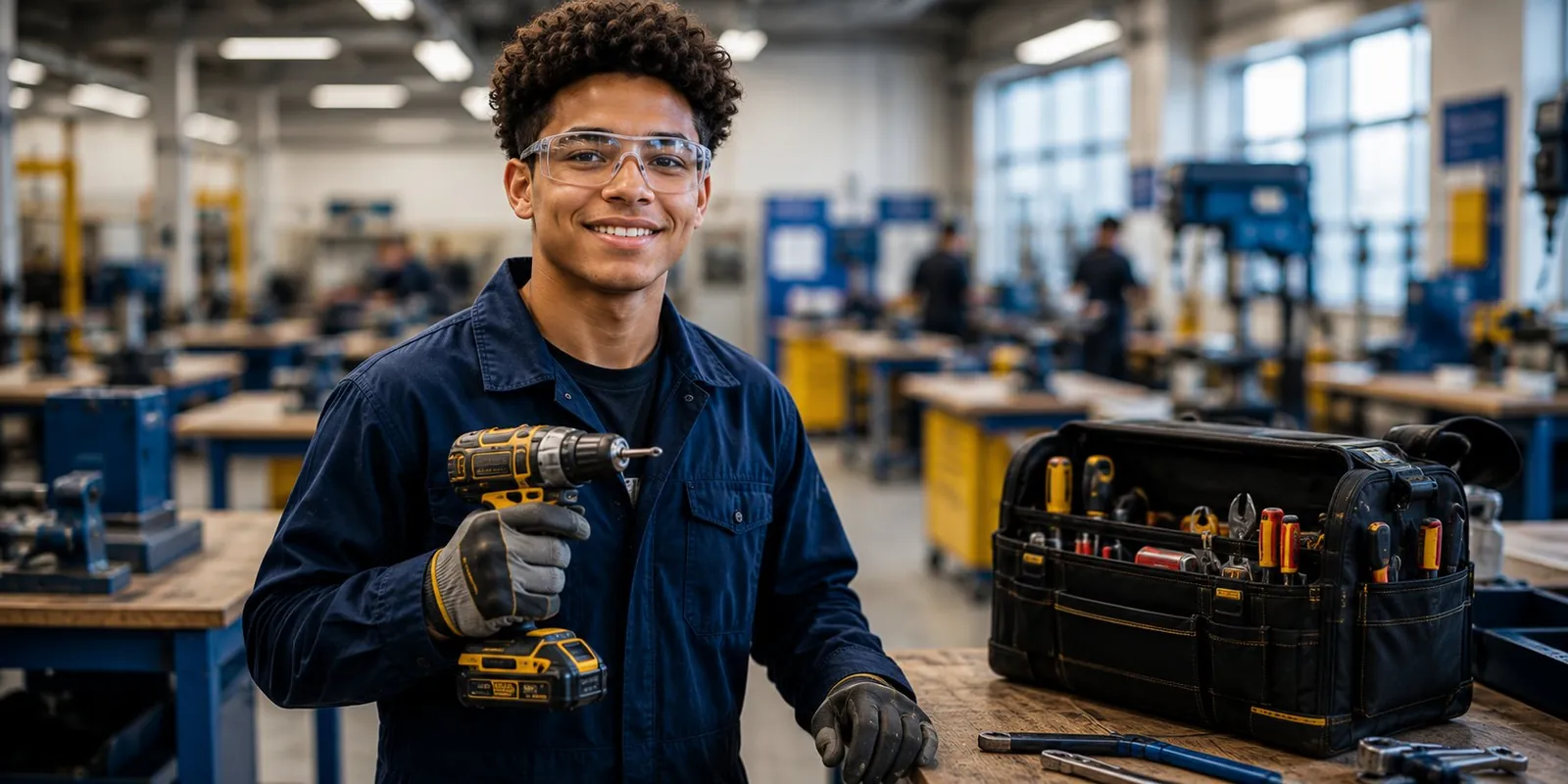
Everyone says the trades need more people. Almost no one explains how you actually get in. This page does. No one in your family works in the trades? Most apprentices start exactly there.
An apprenticeship is a paid job that trains you. You work on real jobsites under experienced pros, take related classes (usually one or two evenings a week or in blocks), and earn raises as you log hours. Most run 3 to 5 years. At the end you hold a journeyman credential, a portable card that proves your skill anywhere in the country. No student debt. Most first-year apprentices earn 40 to 60% of a full journeyman wage, with raises roughly every 6 to 12 months as you log hours.
Registered apprenticeships are regulated by the U.S. Department of Labor, so the wage scales, training hours, and credentials are standardized and real.
Electrician, plumber, HVAC, welder, carpenter, lineworker, they pay and feel very different. Our free 3-minute assessment matches you to trades that fit how you like to work.
Driver’s license, reliable transportation, boots, resume, references. Run through our Apprenticeship Readiness Checklist, your unchecked items become your to-do list.
Search our directory of trade schools, community colleges, and unions, and the federal Apprenticeship Job Finder for registered openings by ZIP code.
Most union programs use a short test: basic algebra and reading comprehension. It’s passable with a few weeks of brush-up, free practice materials exist for every major trade test.
Programs score your interview and place you on a ranked list; openings go top-down. They’re listening for reliability, interest in the trade, and willingness to learn. Practice with our AI Mock Interview.
Accept the offer, complete orientation and safety training, and you’re a paid apprentice. Show up, log your hours, and the raises are written into the program.
Employers tell workforce programs the same list, over and over. None of it is complicated, but nobody tells you unless someone in your life works construction. Now you know:
Typical out-of-pocket startup ranges. Many programs and funding sources cover part or all of this, see our Scholarships & Funding page.
| Trade | Typical startup gear | Typical range* |
|---|---|---|
| Construction laborer / carpentry | Boots, tape, basic hand tools, PPE | $150-$450 |
| Electrician | Boots, hand tools, meter, PPE | $400-$1,200 |
| Plumbing / pipefitting | Boots, hand tools, PPE | $300-$900 |
| HVAC | Boots, hand tools, gauges (often employer-provided) | $250-$800 |
| Welding | Boots, hood, gloves, jacket | $300-$800 |
| CDL / trucking | Permit, DOT physical, endorsements (school often covered) | $200-$600 |
*Typical U.S. ranges; varies by program and region. Union programs frequently provide first tool sets or payroll-deduct them.
Start by picking a trade, then apply to registered programs through unions, trade associations, or employers in your area. Our roadmap walks you through each step.
A registered apprenticeship is a program approved by the U.S. Department of Labor that combines paid on-the-job training with classroom instruction and ends in a nationally recognized credential.
Yes. Most registered apprenticeships take applicants at 18, some at 17 with a diploma or GED, and many pre-apprenticeships start at 16.
Create a free account (or sign in) to save your work, come back anytime, and pick up right where you left off.
Sign Up Free Log In